I thought it would be a fun change of pace to show you one of my latest bookish projects. It's a DIY folded page book sculpture! I was recently given this book for my birthday from my awesome friends Kathryn and Gregg. I had seen these before in bookstores but had assumed that you just bought them already done. To my surprise, it comes as a normal book that you gradually turn into the sculpture (which is by the way, super satisfying).
I got Jane Eyre (one of my absolute favorite classics), which I of course could not help but read here and there as I was working on it. The pages all have asymmetrical gray stripes on them, directing where you should fold the page.
It went surprisingly fast, and it was tons of fun! And without further ado, here's the finished product!
Monday, July 20, 2015
Friday, June 12, 2015
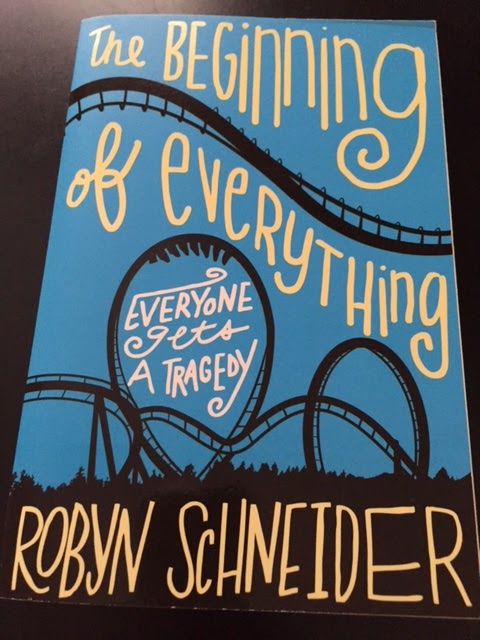
The Beginning of Everything
The Beginning of Everything by Robyn Schneider is a coming of age story about high school student Ezra Faulkner (what a great name). Ezra is a popular tennis star on track to be homecoming king and get the perfect scholarship for the perfect school. But after a party one night Ezra gets into an accident, injuring him and thereby destroying all plans for his future.
While trying to navigate new friend groups, Ezra starts to fall for quirky new girl Cassidy Thorpe. She pushes him to move past his tragedy; to make new, bigger goals instead of accepting a lesser fate.
This was a fun summer read, but the perspective is from rich families living in Florida - which is fine - but sometimes it is presented in a way that feels like every reader must be from a rich family living in Florida. Sometimes I found it hard to relate and other times I really did not know what they were talking about because my high school experiences were so different. But that could just be me.
One other small critique that pulled me out of the story from time to time was how similar the story and characters were to certain John Green books. I know it probably isn't fair to the author to make that comparison (especially since I had just finished Paper Towns), but at times it was a little distracting or predictable.
Overall I enjoyed the book - it was funny, it was cute, the characters were fleshed out well and the ending actually surprised me. I liked the struggle of people knowing the real you versus acting how you think people expect. That was portrayed very well and was a struggle many teens are familiar with. I also loved the thesis of the book - that "everyone gets a tragedy", and you are defined by what beginnings you allow to grow from it instead of finding your identity in the tragedy itself.
Friday, April 24, 2015
Paper Towns
Paper Towns by John Green was such a fun read. High school senior Quentin (Q for short) has grown up next door to the beautiful and mysterious Margo Roth Spiegelman. One night, Margo climbs into his bedroom window and persuades him to join her on a well-thought out revenge mission. After a truly wild night, Q can't wait to see Margo at school in the morning - maybe their social statuses could change and they could be friends in public too. Just one problem - Margo is missing. Q begins to discover that Margo has left him clues to find her, and so he enlists his friends to help him solve the mystery. While Q and his friends get deeper and deeper into the enigma that is Margo, Q begins to wonder if Margo is really the girl he thinks she is.
When I was about half way through this novel, I was worried that it was turning into another tale of the manic pixie dream girl. For those of you that are not familiar with this damaging trope, here's a quick crash course: http://tvtropes.org/pmwiki/pmwiki.php/Main/ManicPixieDreamGirl. And if you really don't care to read it, I will summarize the summary: An MPDG is a quirky woman who brings adventure into the life of a depressive man and (most importantly) has no independent goals of her own - she purely exists to change him and often disappears when she does. In short, it's a flat character, a lazy plot device, and a disappointing, limited view of females as a whole.
But wait! I had faith in John Green and thankfully he knew how dangerous that trope was and in many ways this seemed to be his response to the dangers of the male gaze. Yes, Margo is quirky (not a bad or unrealistic thing) and she does change Q's life (again, a good thing). But he does add a complexity to Margo and an introspection and awareness to Q that is very refreshing. All characters are flawed, dynamic people that can be both selfish and care for others.
I loved the mystery, humor, and realistic high school friendships that John Green has proven to be so great at writing. I highly recommend this for a spring read, and then you can go see the movie this summer!
![]() |
| http://www.amazon.com/Paper-Towns-John-Green/dp/014241493X |
When I was about half way through this novel, I was worried that it was turning into another tale of the manic pixie dream girl. For those of you that are not familiar with this damaging trope, here's a quick crash course: http://tvtropes.org/pmwiki/pmwiki.php/Main/ManicPixieDreamGirl. And if you really don't care to read it, I will summarize the summary: An MPDG is a quirky woman who brings adventure into the life of a depressive man and (most importantly) has no independent goals of her own - she purely exists to change him and often disappears when she does. In short, it's a flat character, a lazy plot device, and a disappointing, limited view of females as a whole.
But wait! I had faith in John Green and thankfully he knew how dangerous that trope was and in many ways this seemed to be his response to the dangers of the male gaze. Yes, Margo is quirky (not a bad or unrealistic thing) and she does change Q's life (again, a good thing). But he does add a complexity to Margo and an introspection and awareness to Q that is very refreshing. All characters are flawed, dynamic people that can be both selfish and care for others.
I loved the mystery, humor, and realistic high school friendships that John Green has proven to be so great at writing. I highly recommend this for a spring read, and then you can go see the movie this summer!
Friday, April 17, 2015
The Snow Child
I realize that The Snow Child by Eowyn Ivey is not the most timely of choices for a springtime read, but when I read it, we were in the midst of blizzard after blizzard so I like to think that it's the thought that counts.
So far, this is my favorite book that I have read this year. In it, two homesteaders named Jack and Mabel try to survive the harsh winter conditions of Alaska in the 1920s. The older couple never had children, and the yearning for one in addition to the isolation and back breaking labor required of them begin to not only affect their marriage, but their mental health and emotional wellbeing.
One night, Jack and Mabel play outside in the snow, finally able to relive the childlike spark that had once been so present in their relationship but had since faded. They make a snow girl and dress her in a coat and mittens and carve delicate features into the snow for her face. They go inside and wake the next morning to see that the snow child and clothes are gone, and in its place the couple can swear that they saw a little blonde girl - in the same coat - running through the woods near their house. The sightings increase, and, as if trying to gain the trust of a wild animal, the couple begin a gentle relationship with this wild girl living in the forest.
I loved the fairy tale elements that are so masterfully woven within the heartache and joy of reality. Jack and Mabel are some of the most relatable characters I have read in a while; no one is simplified, vilified, or deified. There are some very real, very heavy tragedies in this book, but they are balanced so well with moments of unbridled joy and wonder - and those are the moments that really stuck with me.
So far, this is my favorite book that I have read this year. In it, two homesteaders named Jack and Mabel try to survive the harsh winter conditions of Alaska in the 1920s. The older couple never had children, and the yearning for one in addition to the isolation and back breaking labor required of them begin to not only affect their marriage, but their mental health and emotional wellbeing.
One night, Jack and Mabel play outside in the snow, finally able to relive the childlike spark that had once been so present in their relationship but had since faded. They make a snow girl and dress her in a coat and mittens and carve delicate features into the snow for her face. They go inside and wake the next morning to see that the snow child and clothes are gone, and in its place the couple can swear that they saw a little blonde girl - in the same coat - running through the woods near their house. The sightings increase, and, as if trying to gain the trust of a wild animal, the couple begin a gentle relationship with this wild girl living in the forest.
I loved the fairy tale elements that are so masterfully woven within the heartache and joy of reality. Jack and Mabel are some of the most relatable characters I have read in a while; no one is simplified, vilified, or deified. There are some very real, very heavy tragedies in this book, but they are balanced so well with moments of unbridled joy and wonder - and those are the moments that really stuck with me.
Monday, April 6, 2015
The Night Circus
The Night Circus by Erin Morgenstern is the tale of two ill-fated magicians raised by their cruel and eccentric mentors to outsmart their opponent. They grow up not knowing who their opponents are; their only task is to hone their craft and be ready for the game to begin. As you might guess, these two magicians, Celia and Marco, eventually meet and fall in love. Unfortunately, they soon learn that the game they have been preparing for their whole lives is a duel to the death.
Perhaps the third main character in this novel is the setting, the Cirque des Reves. The night circus comes into town without warning, and each tent contains an amazing act, mysterious creatures, or beautiful dream-like gardens. The magic within the circus is not always sleight of hand or illusion, but a real craft that can bring imagination to reality.
I had heard the plot of this book and was very, very excited to read it. I guessed it would be fast paced and full of action, but that was an incorrect assumption. Instead, most of the book is just taking in the fantastic atmosphere of the circus, both as an outsider marveling at each tent, and as a performer helping make and keep the circus running.
The very end of the book speeds up with the duel, as if to make up for lost time. While I was reading it I wasn't quite sure if I liked that, but looking back now I believe that I do. It feels as if you are strolling around for most of the book in a dream, only to be shaken awake at the end to finally watch the fate of Celia and Marco.
I enjoyed reading this - it was something different and I enjoyed seeing the imagination of the author shine through. Also, on a visual note, this was a beautiful book to read. Black pages with twinkling constellations are interspersed throughout to separate certain chapters, very much fitting within the monochromatic theme of the Cirque des Reves.
And just a quick note: I apologize for not being able to regularly update this blog for several months due to my laptop crashing. I have a new one now and look forward to getting back on track! Thank you for your patience!
Thursday, October 23, 2014
The Death Cure
The final installment of the Maze Runner trilogy, The Death Cure by James Dashner, took a little bit of effort for me to get through. I think when you really get down to it, I was enamored with the idea of the maze in the first book, and unfortunately the characters and plot of the second and third books just were not enough to keep me hooked.
(Spoilers, obviously since it's book three...) The Death Cure follows Thomas and the rest of the survivors from various groups as they continue running from WICKED while hoping to stop more innocent people getting sacrificed for the hope of a cure for the Flare. All this culminates into a return to the maze?! Gasp!
Photo from Barnesandnoble.com
I was excited to read this because I had seen a lot of good reviews, and know many people that love this series. I guess it just wasn't my cup of tea. Which is disappointing, because I'm always looking for a new cup of tea to enjoy. I had heard people praise the pacing of the novel. They are right - it's filled to the brim with action and you are never in the same place for too long. But I wonder if that was part of my problem with it. While the reader is taken on a dystopian world tour, I wanted to sit and watch the growth of the characters that I had invested so much time in. I wanted more answers to why WICKED really seemed to be living up to their spooky acronym. But I got more questions. And I didn't get the pay off of Thomas getting back his memories. Maybe we do in the prequel, but that doesn't seem fair to me and I'm not sure if I even want to take a stab at it anyway.
But let me stop myself from getting too cranky (kranky?). I did finally get more development for Newt and Minho, which I was begging for. I still wish I could have had more time with them, but I would say that that's always a good sign when you can't seem to get enough of a character. And for the most part I did enjoy the last quarter of the book. We were headed back to the maze, and you know that in one way or another this will all be over soon. I don't even mean that in a negative way, it's just so much has happened to these characters, you just wish for them to get some rest and answers!
Overall, I was pretty pleased with the ending as well. I wish Thomas had gotten his memories back so we could understand WICKED's motives a little more. They were too evil and too hard to believe all of this would be set up without a cheaper, safer alternative. I would have loved to see Thomas struggle with the morals of his new and old self. I would have loved to see what his real, original connection to Theresa was because I felt like I never really connected to her myself. Alas, I still understand Thomas' motives for choosing against the procedure. I think my absolute favorite parts were Newt's heartbreaking end, and the hope of a new beginning for the others.
Thursday, September 4, 2014
The Invention of Hugo Cabret
I'll jump right into it - I think The Invention of Hugo Cabret by Brian Selznick might just the most beautiful book I've ever experienced. I say experienced because that's what it is, half full page illustrations and historical photos, half whimsical text. Even blank pages are striking in all black, and text pages are bordered with a thick black frame and lovely border.
The narrator instructs us to imagine the story as a film, having us picture the lights going down and the curtains drawing back, all to focus on a small boy named Hugo that has been secretly keeping the clocks running in a train station in France. Hugo is gifted with understanding the inner workings of machines, and in an effort to feel closer to his father has set out to finish the work they started together - building a mysterious automaton.
Hugo begrudgingly can't seem to get rid of a nosy little girl named Isabelle, either, who just might have the connections to solve all of the mysteries that keep popping up. Beautifully woven within Hugo's story is a much larger narrative of the history of film itself, showing us how thrilling it must have been to see this dream world of film for the first time.
I would give the text itself maybe 3 or 4 stars. It's simple and moves the plot along just as fast as it needs to. But the illustrations that act like perfectly placed camera shots (whole pages dedicated to the close up of a boot tiptoeing away, or the nervous glance of an eye as Hugo checks around the corner to see if he is being followed) skyrocket this book to a 5. In one of the chapters, Hugo is researching film in a library, and the narration switches from third person to pure excerpts and pictures from the text book he was reading - I felt like I was researching right along with him. It was just plain fun, and I'll admit toward the end when everything is coming together I might have gotten a chill or two. It just fills you with wonder and you can't wait to see the next page and the next page and the next page. Here are a few of my favorites:
The narrator instructs us to imagine the story as a film, having us picture the lights going down and the curtains drawing back, all to focus on a small boy named Hugo that has been secretly keeping the clocks running in a train station in France. Hugo is gifted with understanding the inner workings of machines, and in an effort to feel closer to his father has set out to finish the work they started together - building a mysterious automaton.
Hugo begrudgingly can't seem to get rid of a nosy little girl named Isabelle, either, who just might have the connections to solve all of the mysteries that keep popping up. Beautifully woven within Hugo's story is a much larger narrative of the history of film itself, showing us how thrilling it must have been to see this dream world of film for the first time.
I would give the text itself maybe 3 or 4 stars. It's simple and moves the plot along just as fast as it needs to. But the illustrations that act like perfectly placed camera shots (whole pages dedicated to the close up of a boot tiptoeing away, or the nervous glance of an eye as Hugo checks around the corner to see if he is being followed) skyrocket this book to a 5. In one of the chapters, Hugo is researching film in a library, and the narration switches from third person to pure excerpts and pictures from the text book he was reading - I felt like I was researching right along with him. It was just plain fun, and I'll admit toward the end when everything is coming together I might have gotten a chill or two. It just fills you with wonder and you can't wait to see the next page and the next page and the next page. Here are a few of my favorites:
Subscribe to:
Posts (Atom)